- Empty cart.
- Continue Shopping


Last week’s big tech buzz was that OpenAI bought Jony Ive’s design studio — the same Jony Ive who shaped Apple’s iconic designs. They’re teaming up to create some mysterious new “AI devices” — and yes, the deal is worth billions again. But what exactly these devices will do? No one’s saying clearly.
Soon after, leaks started to spill out, giving us a vague idea of what’s coming. And honestly? The more I read, the more it felt like people are going to hate these things.
If OpenAI really does launch a hardware product, the public reaction might make the backlash against Google Glass — which got shut down a decade ago — look like a warm welcome. We’re talking about a device that’s “always on,” possibly worn around your neck, listening and watching your surroundings… all the time.
According to the Wall Street Journal, OpenAI’s CEO Sam Altman told his team that the device won’t be a phone or smart glasses. But it will be portable, always active, and capable of sensing your environment. He’s confident it’ll be a hit — claiming it could add $1 trillion to OpenAI’s value. He even said they’d sell 100 million units faster than any tech company ever has.
Meanwhile, tech analyst Ming-Chi Kuo reported that:
The current prototype is a bit bigger than the “AI Pin” (another wearable).
It’s as compact as an old iPod Shuffle.
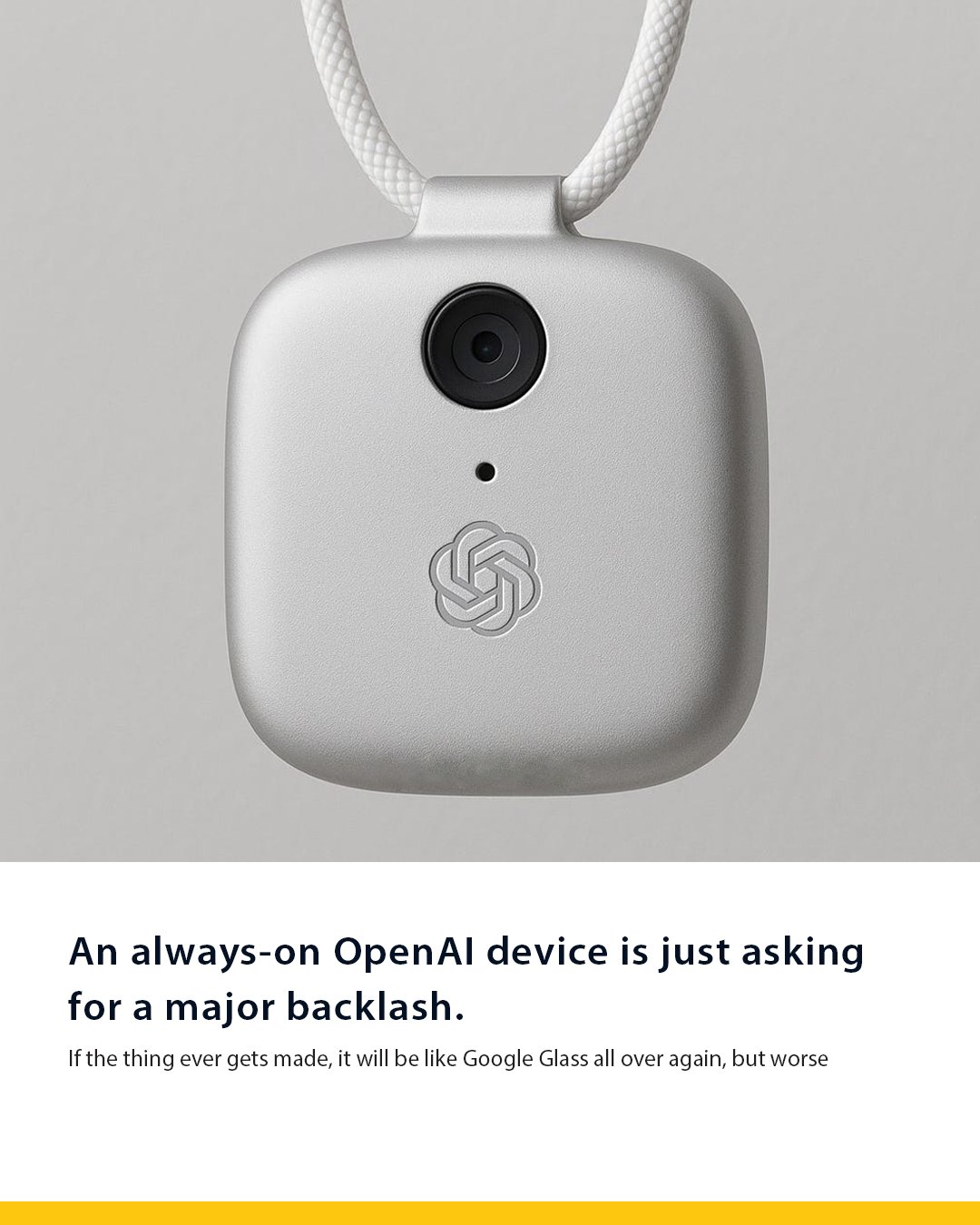
It’s meant to hang around your neck.
It has cameras and microphones — but no screen.
It’ll rely on your phone or PC for processing and display.
One designer even created an AI mockup of what it might look like — and while sleek, it raises big questions. Do we really want a device that records everything around us? In a place like Kerala, where privacy and human connection still matter, something like this could feel intrusive, even unsettling.
Sometimes, tech moves faster than society is ready for — and when that happens, it’s not innovation, it’s invasion.